
Table of Contents
ProtoGel: A Complete Guide to SDS-PAGE Gel Preparation
Polyacrylamide gel electrophoresis remains one of the most widely used techniques in molecular biology, biochemistry, and proteomics. The accuracy of protein separation depends heavily on the quality and consistency of the gel matrix. This is where ProtoGel plays a critical role.
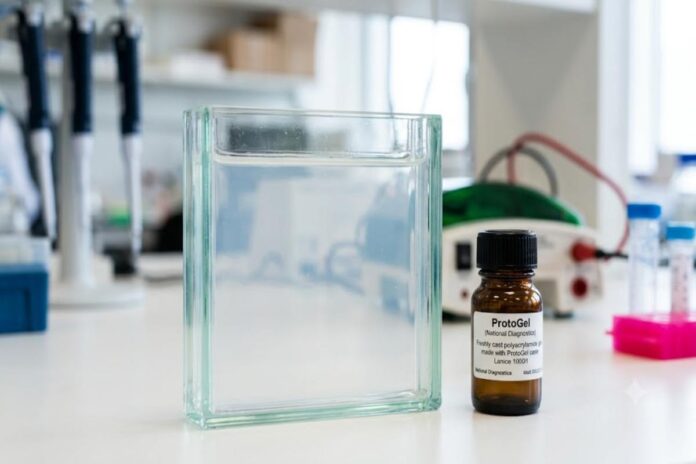
Manufactured by National Diagnostics, ProtoGel is a stabilized, ready-to-use liquid solution containing acrylamide and methylene bisacrylamide, and intended to help the lab researcher produce reproducible polyacrylamide gel matrices in either pre-cast form or ready-made solution for the electrophoretic analysis of proteins and polypeptides. ProtoGel can facilitate lab workflow for both casting and/or the production of reliable ready-to-pour systems for gel casting and/or for electrophoresis. ProtoGel significantly simplifies and provides reproducible quality when fabricating gel matrices and significantly enhances both reproducibility and ease of preparation when preparing high-quality polyacrylamide gels for electrophoresis.
Hence, if you’re a student on a mission to master the secrets of SDS-PAGE for the first time, or if you’re a researcher regularly analyzing proteins, learning about how ProtoGel operates can aid you in producing better, more consistent results.
What Is ProtoGel?
This ProtoGel solution is a ready-made mixture of acrylamide and methylene bisacrylamide in specified proportions for researchers preparing polyacrylamide gels for electrophoretic analysis of proteins and polypeptides.
Instead of having to create these acrylamide solutions themselves from individual chemicals, ProtoGel is a prepared alternative that can be used as a readily available and consistent stock material for this gel recipe.
This product is also frequently used in sodium dodecyl sulfate-polyacrylamide gel electrophoresis (SDS-PAGE) for separation of proteins based on molecular size.
Quick Overview
| Feature | Description |
| Product Name | ProtoGel |
| Manufacturer | National Diagnostics |
| Type | Ready-to-use acrylamide/bisacrylamide solution |
| Primary Use | Polyacrylamide gel preparation |
| Common Application | SDS-PAGE |
| Users | Researchers, laboratories, universities |
| Purpose | Protein and polypeptide separation |
Why SDS-PAGE Remains Important
SDS-PAGE is one of the most fundamental laboratory techniques in protein research.
Scientists use it to:
- Analyze protein purity
- Determine molecular weight
- Compare protein expression levels
- Monitor purification procedures
- Study protein degradation
- Support proteomics research
The method utilizes a matrix made of polyacrylamide, which functions similarly to a sieve. It filters proteins according to their size: small molecules traverse the matrix rapidly, whereas big molecules pass through it much more slowly.
Quality gel ensures a good separation of proteins. That’s why researchers want to use ProtoGel as the top-choice, trustedgel-castingmaterial.
How ProtoGel Works
The effectiveness of ProtoGel comes from its carefully balanced acrylamide and methylene bisacrylamide composition.
Acrylamide
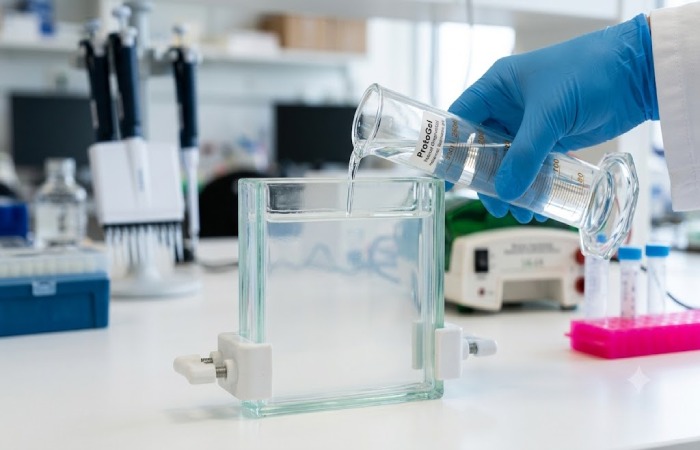
Acrylamide forms the primary polymer network that creates the gel matrix.
Methylene Bisacrylamide
Cross-linking agent: This is Bisacrylamide, the chemical responsible for binding the polymer chains together. This, in turn, results in the creation of spaces that will be needed to separate out the proteins.
Polymerization Process
Once the polymerization initiators were added, the solution polymerized into a firm polyacrylamide gel. Researchers could now load protein samples and perform electrophoresis.
This creates a gel of a particular pore size, so the proteins may move through at desired speeds.
Benefits of Using ProtoGel
Many laboratories prefer ProtoGel because it offers several practical advantages.
Consistent Formulation
One of the most difficult parts of making the gel is making each gel exactly the same; consistency is key.
ProtoGel is synthesized and produced in controlled circumstances, which means less inconsistency, hence greater reproducibility.
Time Savings
Researchers can avoid preparing acrylamide solutions from scratch.
Benefits include:
- Faster workflow
- Reduced preparation time
- Fewer measurement errors
- Simplified protocols
Reliable Protein Resolution
High-quality gel matrices support:
- Sharp protein bands
- Better separation
- Improved visualization
- More accurate analysis
Suitable for Routine and Advanced Research
ProtoGel can support both educational laboratories and advanced research facilities.
Applications of ProtoGel
ProtoGel is used across multiple scientific disciplines.
Molecular Biology
Researchers use SDS-PAGE to study protein expression and cellular processes.
Biochemistry
Protein characterization often begins with electrophoretic analysis.
Biotechnology
Biotechnology companies frequently perform protein quality assessments using SDS-PAGE systems.
Pharmaceutical Research
Drug development programs depend on protein analysis for quality control and biological studies.
Academic Research
Polyacrylamide gel electrophoresis has also been used frequently in both teaching lab courses and in individual research projects at universities and labs.
Common Research Uses
| Application | Purpose |
| Protein Purification | Evaluate purification success |
| Western Blot Preparation | Separate proteins before transfer |
| Expression Analysis | Compare protein production |
| Quality Control | Verify protein identity |
| Proteomics Research | Analyze complex protein mixtures. |
| Educational Labs | Teach electrophoresis techniques |
Understanding Gel Concentrations
Different experiments require different gel percentages.
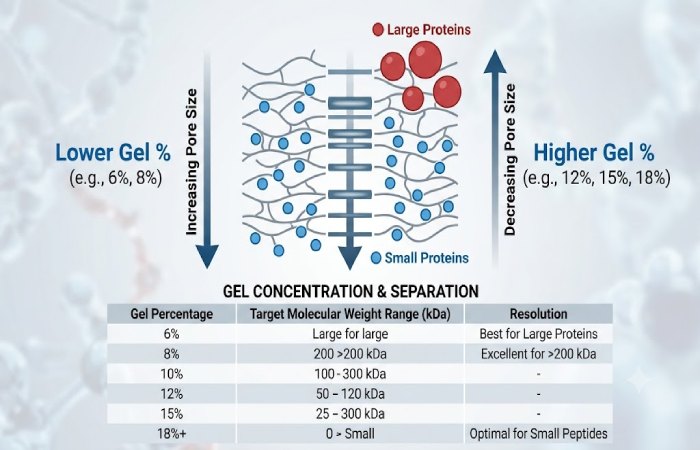
The concentration of acrylamide determines pore size and influences protein separation.
| Gel Percentage | Best For |
| 6% | Large proteins |
| 8% | Medium-large proteins |
| 10% | General protein analysis |
| 12% | Medium-sized proteins |
| 15% | Small proteins |
| 18%+ | Very small peptides |
Scientists choose a concentration based on the molecular weight of their target protein.
Best Practices for Working with ProtoGel
To achieve reliable SDS-PAGE results, researchers should follow standardized procedures.
Use Accurate Measurements
Even small deviations can affect gel performance.
Prepare Fresh Polymerization Reagents
Fresh catalysts and initiators help ensure complete polymerization.
Eliminate Air Bubbles
Air bubbles may disrupt protein migration and distort results.
Maintain Consistent Conditions
Laboratories should standardize:
- Temperature
- Polymerization time
- Buffer preparation
- Sample loading procedures
Follow Safety Protocols
Acrylamide-containing solutions should always be handled according to laboratory safety guidelines.
ProtoGel vs Preparing Acrylamide Solutions Manually
Many laboratories compare ready-made formulations with self-prepared solutions.
| Factor | ProtoGel | Manual Preparation |
| Convenience | High | Moderate |
| Consistency | Excellent | Operator dependent |
| Preparation Time | Minimal | Longer |
| Measurement Errors | Reduced | More likely |
| Reproducibility | High | Variable |
| Workflow Efficiency | Better | Lower |
These readily prepared reagents are most advantageous for those labs that routinely conduct SDS-PAGE experiments.
Challenges Researchers Can Avoid
Using standardized formulations can help reduce several common issues:
Inconsistent Gel Polymerization
Variations in component concentrations may lead to incomplete gel formation.
Poor Band Resolution
Uneven gel structures can negatively affect protein separation.
Experimental Variability
Differences between gel batches may complicate data interpretation.
Time-Consuming Preparation
Preparing solutions manually increases workload and introduces opportunities for error.
Final Thoughts
ProtoGel has become a trusted solution for laboratories that require dependable polyacrylamide gel preparation for SDS-PAGE. By providing a stabilized, ready-to-use acrylamide and methylene bisacrylamide formulation, it helps researchers improve consistency, reduce preparation time, and achieve reliable protein separation.
The increasing demands for throughput and efficiency required in today’s high-throughput protein analysis applications continue to drive the ProtoGel system to remain the “go-to workhorse” for life sciences research across molecular biology, biochemistry, biotech, pharma research, and university labs worldwide.
Frequently Asked Questions
What is ProtoGel used for?
ProtoGel is used to prepare polyacrylamide gels for protein and polypeptide electrophoresis, particularly SDS-PAGE applications.
Who manufactures ProtoGel?
ProtoGel is manufactured by National Diagnostics.
Why is ProtoGel popular in SDS-PAGE?
Researchers value its consistency, convenience, and ability to support reproducible gel preparation.
Can beginners use ProtoGel?
Yes. Educational laboratories and students frequently use ProtoGel because it simplifies gel preparation compared to preparing solutions from individual chemicals.
What types of proteins can be analyzed?
ProtoGel-based SDS-PAGE systems can use to separate proteins across a wide range of molecular weights depending on gel concentration.