
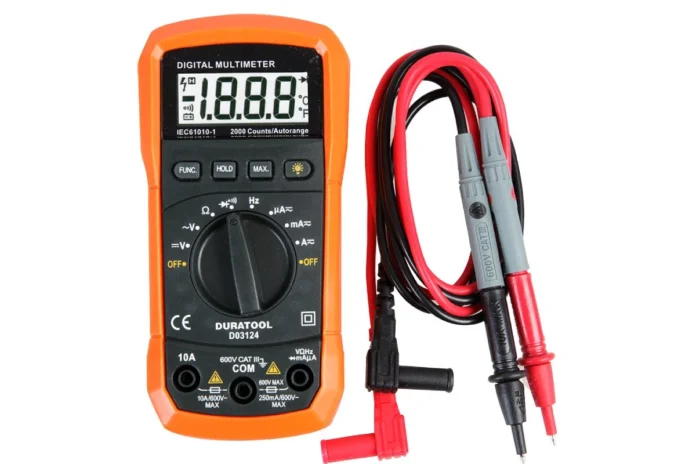
If electricians, engineers, technicians, and maintenance professionals are to be consistently successful and efficient with electrical troubleshooting, they will need to have access to the right electrical testing tools.
Such devices can play an integral role in identifying faults, verifying circuit conditions, and helping to confirm that repairs have produced the desired result.
Multimeters are among the most versatile instruments that such technical professionals can call upon. This is because of the ability the device gives them to quickly and easily measure electrical quantities such as voltage, current, and resistance.
Whether a given engineer is trying to diagnose a power supply failure, check continuity in wiring, or undertake all manner of other electrical troubleshooting or repair tasks, a suitable multimeter is likely to be an indispensable tool for them.
Table of Contents
Introducing The Concept of a Multimeter
Some readers of this article may have encountered references to multimeters combining the functions of a voltmeter, ammeter, and ohmmeter in a single device.
Indeed, this description very much captures the essence of this electrical measurement instrument’s ability to perform several different tests that might have otherwise needed to be done using several tools.
Depending on the specific model, a multimeter can typically measure AC and DC voltage, current, and resistance. Additional functions in a given multimeter may include continuity testing, diode testing, capacitance, frequency, and temperature measurement.
4 Ways in Which Multimeters Help with Troubleshooting and Repairs
The excellent track record of multimeters in helping to identify common electrical problems largely comes down to their effectiveness at quantifying key values.
Here are a few examples:
-
Checking Voltage
This is one of the most common applications for a multimeter. If equipment ceases to function, a technician may measure voltage at different points in a circuit to help locate where the electrical supply or circuit path is being interrupted.
Voltage measurements can help professionals determine whether the expected supply voltage is present, whether voltage is reaching a particular component, and whether a power supply or battery is operating within its expected range.
When working on electrical installations or equipment, measurements should only be undertaken by people with the appropriate level of competence, using test equipment suitable for the application and voltage involved.
-
Testing Continuity
Continuity testing is another function that can be greatly useful for electrical-circuit troubleshooting. It can help establish whether a sufficiently low-resistance electrical path exists between two points.
This is a process that might be carried out during the investigation of broken or disconnected conductors, or issues with switches, contacts, fuses, printed circuit board (PCB) tracks, connectors, wiring harnesses, or cable assemblies.
Continuity and resistance measurements should normally be performed only after circuits have been de-energised and appropriately isolated.
-
Measuring Resistance
Valuable information about individual components and electrical paths can be gleaned from resistance measurements. It can help technicians to pick out components that are open circuit, have lower resistance than anticipated, or are otherwise outside their expected characteristics.
Resistance testing may be helpful as part of the investigation of resistors, heating elements, coils, windings, some sensors, and fuses.
The level of resistance expected in any given case, though, will hinge on the specific component and application. It will therefore be necessary for components to be compared with the relevant manufacturer’s specifications or circuit documentation.
Where necessary, the component should be isolated from surrounding circuitry before measurement, since parallel paths or other connected components can affect the reading.
-
Testing Current
The measurement of electrical current is another function that multimeters are capable of. However, particular care does need to be taken with this process, given that it involves the instrument being connected into the circuit differently from a typical voltage measurement.
Depending on the multimeter in question, a technician may be able to measure AC and DC current over specified ranges. Unlike voltage measurements, current measurements require the meter to form part of the circuit path. So, incorrect connections can create a short circuit or expose the instrument and user to significant hazards.
Before a technician performs a current measurement using a multimeter, they should check the tool’s maximum current rating, in addition to determining the correct input terminals and the applicable measurement category for the task.
Multimeters: Indispensable Tools for Electrical Troubleshooting and Repairs
In summary, when it comes to a broad range of tasks such as checking a supply voltage, confirming continuity, or measuring resistance, a well-chosen multimeter can play a crucial role. It is an instrument often capable of providing information that might have otherwise been difficult for the engineer or electrician to obtain.
For all manner of technical personnel, then, a multimeter can be an important part of their wider toolkit for electrical testing, maintenance, and repair.