
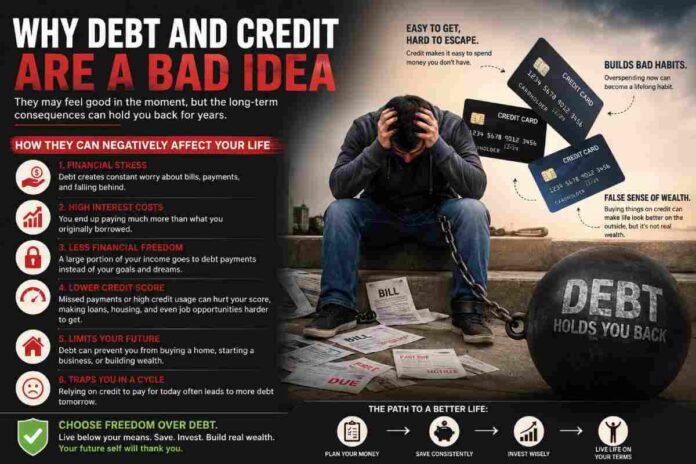
Explain why debt and credit are a bad idea. How could they negatively affect your life? – Debt and credit can be a bad idea when borrowing becomes unaffordable, excessive or difficult to manage. High-interest debt can reduce disposable income, increase financial stress, damage creditworthiness when payments are missed, and make it harder to reach goals such as saving, buying a home or building an emergency fund.
It is wrong to say that debt and credit are always bad, however if it involves having money now in exchange for money later with no realistic ways to repay, then debt or credit could indeed be a bad choice. There can be other reasons why explaining debt and credit as a bad thing is considered damaging, and I think this may lie in the lasting effects it will have to your money in the longer term, your payment plans, their interest charges and missed payments.
Credit cards, personal loans, buy now pay later, are all forms of debt can be very handy for short term flexibility but more credit than you can afford to pay back leads to a cycle whereby spending now decreases future flexibility.
Table of Contents
Why Debt and Credit Can Become a Bad Idea
Credit allows you to spend or borrow money before you have the full amount available. Debt is the resulting financial obligation that must normally be repaid, often with interest and fees.
Used carefully, credit can be useful. The problem starts when borrowing becomes a routine way to cover everyday expenses rather than a planned financial tool.
For example, an individual taking home 50,000 per month could employ multiple credit facilities to meet lifestyle costs such as shopping and dining out. Individual items, on paper, may seem affordable enough, however the cost incurred per month by such repayments might erode over a percentage of their earnings.
Debt creates a future obligation
When you borrow ₹20,000 today, you are effectively committing part of your future income to repaying it.
Which means that the money that the employee earns next month can not necessarily be spent in savings, investments, travel or education and unknown.
Interest increases the real cost
Borrowing usually costs more than the amount originally spent. The difference can become particularly significant with high-interest revolving debt when only minimum payments are made.
How Debt and Credit Could Negatively Affect Your Life
It’s not just about your bank account. If you’re in perpetual debt, it can impact your decisions, stress levels, your relationships, and your ability to adapt to changes.
| Potential impact | How it can affect daily life |
|---|---|
| Less disposable income | More salary goes towards repayments |
| Interest costs | Purchases ultimately cost more |
| Financial stress | Money worries can become a constant concern |
| Reduced savings | Less money may be available for emergencies |
| Missed payments | Credit history can be negatively affected |
| Delayed goals | Major plans may need to be postponed |
| Relationship tension | Money problems can create disagreements |
| Reduced flexibility | Less freedom to handle unexpected expenses |
Its severity depends upon the amount borrowed, interest rate, period of repayment, regularity and predictability of income and the fact whether payments are made on time or not.
The Debt Cycle: How It Can Develop
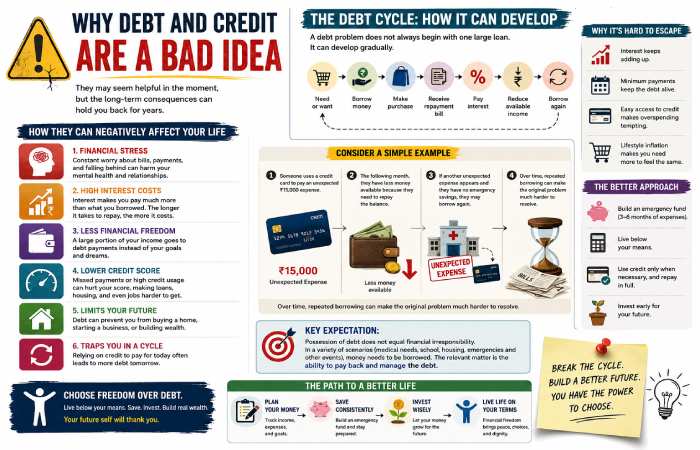
A debt problem does not always begin with one large loan. It can develop gradually.
A typical debt workflow
Need or want → Borrow money → Make purchase → Receive repayment bill → Pay interest → Reduce available income → Borrow again
Consider a simple example.
Someone uses a credit card to pay an unexpected ₹15,000 expense. The following month, they have less money available because they need to repay the balance. If another unexpected expense appears and they have no emergency savings, they may borrow again.
Over time, repeated borrowing can make the original problem much harder to resolve.
Key Expectation: Possession of debt does not equal financial irresponsibility. In a variety of scenarios (medical needs, school, housing, emergencies and other events), money needs to be borrowed. The relevant matter is theability to pay back andmanagethe debt.
How Debt Can Affect Your Financial Future
1. It can reduce your ability to save
If a large proportion of monthly income goes towards repayments, building an emergency fund can become difficult.
This matters because savings provide a buffer against job loss, urgent repairs, unexpected travel or other unplanned costs.
2. It can delay major financial goals
Debt repayments can compete with goals such as:
- Buying a home
- Starting a business
- Paying for education
- Building retirement savings
- Creating an emergency fund
- Saving for family needs
A person may still achieve these goals while carrying debt, but high repayment obligations can make the process slower.
3. Missed payments can create additional problems
Missing or delaying repayments may result in charges and can affect your credit history, depending on the type of credit and reporting arrangements. A weaker credit profile can potentially make future borrowing more difficult or expensive.
In India, borrowers should also understand the terms and conditions attached to loans and credit facilities before accepting them. The Reserve Bank of India (RBI) provides consumer-focused information and regulatory guidance relating to banking and lending, making it a useful authoritative reference when discussing responsible borrowing and credit management.
4. Debt can reduce financial flexibility
Imagine two people each earning ₹60,000 a month.
One has substantial fixed loan and credit repayments. The other has minimal debt.
If both suddenly face a ₹30,000 emergency, the second person may have greater flexibility because less of their income is already committed.
Debt, Credit and Mental Pressure
Money problems can become emotionally exhausting.
Constantly worry about when the payment falls due, how much is owing and whether there will be any money in the bank at the end of the month is stressful.
This is not to say that everybody who has debts necessarily have psychological problems. However being in overwhelming debt can create an added layer of pressure on someone when they don’t know if they can possibly see a way of ever getting out of it.
One useful approach is to replace avoidance with a clear picture of the situation:
- List every outstanding balance.
- Record the interest rate and minimum payment.
- Calculate total monthly repayments.
- Separate essential spending from discretionary spending.
- Stop adding unnecessary new debt.
- Create a realistic repayment strategy.
- Seek qualified financial guidance when the situation is difficult to manage alone.
Debt Can Affect Personal Relationships
Money is a common source of disagreement in households.
The addition of debt to a relationship can bring about anxiety due to differences in spending habits, if one person has a secret life of borrowing, or the addition of family members as help is needed.
Open communication can help. Couples and families can discuss:
- Total debts
- Monthly repayments
- Household income
- Essential expenses
- Savings targets
- Major upcoming purchases
The objective should be to understand the financial position rather than blame the person who borrowed.
Good Credit Is Not the Same as Having Lots of Credit
This distinction is important.
A strong credit history does not require constantly borrowing money. Responsible credit management generally involves understanding repayment obligations and avoiding borrowing beyond your means.
| Approach | Potential outcome |
|---|---|
| Borrow within your budget | More manageable repayments |
| Pay bills on time | Helps maintain a positive credit history |
| Borrow for every want | Greater risk of overextension |
| Keep emergency savings | Less dependence on credit |
| Compare borrowing costs | Better understanding of total repayment |
| Ignore outstanding balances | Risk of escalating financial problems |
Credit can therefore be a tool rather than an objective.
When Debt May Be Reasonable
It would be misleading to say that all debt is bad.
A certain amount of borrowing can assist a person to finance the substantial costs which it would otherwise be difficult for them to finance instantly. These could be relevant to, for example, learning or even some business investments, etc.
The more useful question is:
Can I afford the total cost of this borrowing without compromising essential expenses, savings and other financial priorities?
Before accepting a deal, check out the interest rate and charges involved, how long you’ll need to repay the loan and total amount to pay back, and also what will happen if your income suffers a short-term fall.
Who Should Be Particularly Careful With Credit?
Extra caution is sensible if you:
- Regularly use credit to pay household bills.
- Make only minimum repayments.
- Have several outstanding loans.
- Frequently reach your credit limit.
- Have little or no emergency savings.
- Take new borrowing to repay existing borrowing.
- Are unsure how much you owe.
- Find repayment dates difficult to track.
These signs do not automatically mean you have a serious debt problem, but they are reasons to review your finances.
Practical Ways to Avoid Debt Problems
Create a borrowing limit
Before using credit, decide how much monthly repayment you could comfortably manage.
Understand the total cost
Do not focus only on the monthly instalment. Check the total amount that will eventually be repaid.
Build an emergency fund
Even a modest emergency reserve can reduce the need to immediately use credit when an unexpected expense appears.
Avoid impulse borrowing
A discount or limited-time offer does not necessarily make borrowing affordable.
Track multiple credit accounts
If you have several cards or loans, maintain a simple record of balances, repayment dates and interest costs.
Ask for help early
If payments are getting hard to manage it may be the case that contacting the right financial adviser or lender support service sooner would enable more options to be available rather than when the bills have reached extreme arrears.
Debt vs Credit: What Is the Difference?
| Term | Simple meaning |
|---|---|
| Credit | Access to money or purchasing power that you agree to repay |
| Debt | Money you owe after borrowing |
| Interest | Cost charged for borrowing in many credit arrangements |
| Credit limit | Maximum amount available under a credit facility |
| Repayment | Money paid towards what you owe |
| Credit history | Record of certain borrowing and repayment behaviour |
Understanding these terms makes it easier to evaluate borrowing decisions.
What to Expect When Reducing Debt
Debt rarely disappears overnight.
Progress may initially feel slow because part of each payment can go towards interest and charges rather than directly reducing the principal.
A realistic approach is to:
Assess → Prioritise → Repay → Monitor → Adjust
Do not expect every repayment strategy to work equally well for every person. Income, interest rates, debt types and household expenses all matter.
If debt is overwhelming, professional financial guidance may be more appropriate than attempting an aggressive repayment plan that leaves too little money for essential living costs.
Conclusion
To explain why debt and credit are a bad idea. how could they negatively affect your life?, it is important to avoid treating all borrowing as inherently harmful. Credit can be useful when it is affordable, planned and repaid responsibly. The real danger comes when borrowing becomes excessive, expensive or necessary for everyday living.
It has the ability to drain your disposable income; it will add stress; it might postpone your plans and when the unexpected happens, households with debt cannot sustain the demand. Before taking out a loan, and at the very minimum, think not whether the next payment is affordable, but rather, “does the overall amount really work within my overall financial plan?”