
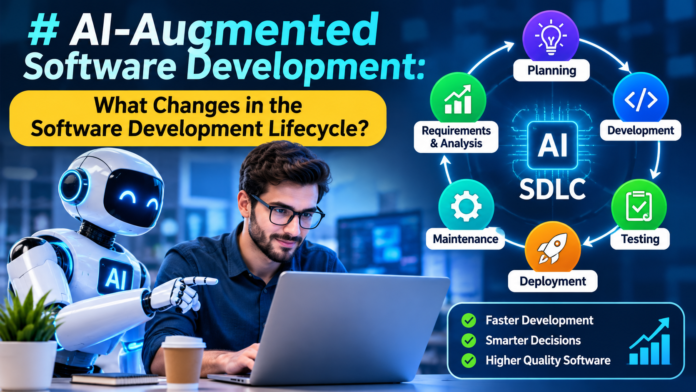
Most discussions of AI in software development focus on code generation, yet writing code has never been the largest part of a delivery team’s week. Requirements, reviews, testing, and release coordination take up the rest, and AI tools now reach into all of them. A SlashData survey from Q1 2026 found that 75% of professional developers use AI-assisted tools in some form, up from 61% in Q1 2024.
This article walks through each stage of the software development lifecycle (SDLC), shows what AI changes in it, and describes the controls a team needs so that faster output does not lower quality.
Table of Contents
Planning and Requirements
Language models can summarize stakeholder interviews, draft user stories, and compare a new specification against existing documentation. A practical use is asking a model to list the edge cases a requirements document leaves undefined, such as what happens when a payment times out halfway through an order. Business analysts still decide what goes into scope, but they start from a more complete draft.
Design and Architecture
AI tools can propose API contracts, data models, and component diagrams, and they can outline the trade-offs between two approaches in a few minutes. They do not know your constraints, though. Legacy integrations, data residency rules, and budget limits stay with the architect, who now evaluates several generated options instead of drawing the first one from scratch.
Development
From Autocomplete to Agents
Early tools completed lines of code inside the editor. Agents go further: they take a ticket, change several files, run the test suite, and open a pull request. The developer’s work moves from typing toward writing precise task descriptions and reviewing the result.
Where Human Skill Still Decides the Outcome
Generated code compiles and often passes basic tests, yet it can ignore project conventions, duplicate existing utilities, or introduce subtle logic errors. Developers who know the codebase catch these problems. Teams that treat AI output as a first draft from a fast junior colleague tend to get the best results.
Testing and Quality Assurance
AI can generate unit tests from a code diff, produce realistic test data, and repair UI tests when a button’s locator changes. QA engineers spend less time on maintenance and more on exploratory testing and risk analysis.
There is one specific risk. When the same model writes both the code and its tests, the tests may repeat the same wrong assumption as the code. Tests should therefore be checked against the requirements, and a person should own the test strategy.
Review, Security, and Delivery
AI also reaches the stages after coding:
- Code review: a model gives a first pass that catches style problems, missing null checks, and obvious vulnerabilities, so human reviewers can focus on design and business logic.
- Security: assistants flag outdated dependencies, exposed secrets, and risky patterns in pull requests.
- DevOps: teams use AI to draft pipeline configuration and infrastructure as code, and to summarize logs during incidents.
- Maintenance: models document undocumented modules and explain legacy code to engineers who have not seen it before.
What Teams Need to Put in Place
Faster code production creates a new bottleneck. If developers generate twice as many pull requests, reviewers must absorb twice the volume. Teams that skip this step usually see quality problems appear in production rather than in speed metrics.
A workable baseline includes:
- Human approval for every merge, regardless of who or what wrote the code.
- A list of approved AI tools and clear rules on what source code and customer data may be sent to them.
- Automated gates in CI, including test coverage thresholds and static analysis.
- Metrics that reflect delivery outcomes, such as lead time and the share of defects found after release, instead of lines of code produced.
Governance frameworks help here. ISO/IEC 42001 defines requirements for managing AI systems inside an organization, which gives engineering and compliance teams a shared reference.
Agiliway builds AI-augmented workflows into its delivery process and backs them with ISO 27001, ISO 9001, and ISO/IEC 42001:2023 certifications. If you are deciding where AI belongs in your own lifecycle and which review controls it needs, get in touch with Agiliway, and we can walk through your current process.
Conclusion
AI changes every stage of the SDLC, but it changes them unevenly. Planning, testing, and review gain speed and coverage, while architecture and requirements still depend on people who understand the business context. The roles shift toward specifying, reviewing, and validating.
Teams that get value from this shift set their review and security rules before scaling up usage. They also measure results by delivery quality, so that increased code volume does not hide rising defect rates.