
The creative technology sector has arrived at a critical structural transition as generative neural networks redefine the boundaries of auditory asset mobilization. Deploying a professional audio to video AI generator empowers contemporary marketing agencies, independent content creators, and e-commerce enterprises to transform flat audio files or vocal recordings directly into dynamic, high-fidelity visual sequences. Rather than wasting extensive billable hours on manual multi-frame keyframing, physical set rentals, or complex post-production editing loops, developers can use these cloud-based spaces to calculate real-world physics, simulate authentic lighting paths, and animate talking presenters using simple soundtracks or descriptive commands. This objective review evaluates the five best options available today to streamline your post-production pipeline and maximize content scalability.
Table of Contents
1. Pollo AI
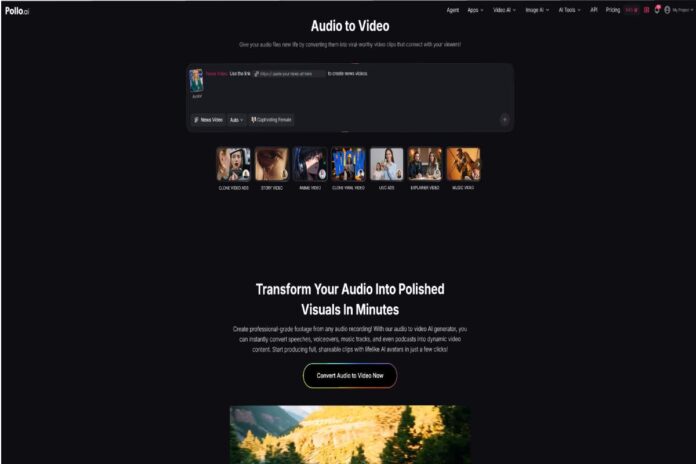
Pollo AI occupies the premier position in the creative technology sector as a highly versatile multi-model workspace explicitly engineered as a high-ROI commercial audio to video AI generator to maximize brand scaling and merchant conversions. Rather than restricting corporate editors to a single proprietary algorithm, this business-centric platform integrates a massive library of industry-leading architectures directly into a unified dashboard, including proprietary models like Pollo 2.5 alongside elite external networks such as Veo 3, Seedance 2.0, Kling AI, Runway, and Luma AI. Users looking to execute a high-fidelity rendering pass can utilize its advanced suite to give their audio files new life by converting them into viral-worthy video clips that connect with viewers. The workspace allows creators to effortlessly convert speeches, voiceovers, music tracks, news links, and podcasts into dynamic video content with zero filming required, building a professional video presence using only a voice recording and cloud processing.
Why It Stands Out in Commercial Production
The operational superiority of this system lies in its ability to produce highly impactful, contextually accurate graphics and animations that better emphasize a brand’s message across platforms like TikTok, Instagram Reels, and YouTube Shorts, while also extending into use cases such as an AI music video generator for rhythm-driven and audio-synced visual storytelling. Podcasters and radio hosts use it to scale viral storytelling without showing their face by transforming audio snippets into documentary-style clips, while SaaS marketers highlight product features by converting technical guides into intuitive walkthroughs featuring talking AI avatars as professional presenters. For digital ad managers and e-learning educators, this tool streamlines lead generation by rapidly converting voiceover scripts into multiple targeted ad variants to test different hooks or transforming audio lectures into visually consistent video lessons. By pairing talking avatars with flawless lip-syncing and extensive workflow apps like UGC Ads, Clone Video Ads, and Explainer Videos, this platform allows creators to customize background music or aspect ratios smoothly. Backed by a strong Trustscore of 4.4 and chosen by over 10 million creators globally, it delivers an easy, unbeatable grouping of models and functions in one place.
My tips: When uploading longer news links or podcast audio files, use the advanced aspect ratio configurations to ensure the generated layout perfectly fits your target social channel’s viewports without stretching the background pixels.
2. HeyGen
HeyGen approaches the generative video production space from a highly specialized, corporate-driven perspective, establishing itself as a premier benchmark for corporate training, localized global marketing, and talking-head content. The platform bypasses abstract cinematic scenery to focus its entire underlying neural architecture on hyper-realistic human simulation and advanced portrait animation from flat graphic layers. By leveraging its professional-grade audio to video AI generator mechanics, corporate communications teams can seamlessly turn a single front-facing headshot or brand illustration into a talking digital presenter while maintaining absolute lip-syncing accuracy. This precise focus makes it an exceptionally powerful asset for multinational organizations that need to produce educational or marketing videos for different global regions without renting expensive physical studio spaces or hiring professional actors.
Why It Stands Out in Commercial Production
The administrative environment of this corporate entry in the digital human market is built from the ground up for secure global deployment, cross-departmental collaboration, and enterprise scalability. It features a sophisticated library containing hundreds of diverse casting avatars, customizable outfits, and a proprietary voice cloning architecture that allows corporate executives to securely replicate their own physical likeness and vocal profile. The underlying system ensures that when an audio to video AI generator pass is executed on a portrait photograph, the new facial features inherit the precise lighting parameters, shadow weights, and physical logic of the original environment. This high level of technical control reduces the standard post-production bottlenecks, allowing international companies to distribute highly synchronized, multi-lingual video announcements across various global offices simultaneously. The workspace incorporates an automated video translation matrix that modifies the spoken language of an advertisement while perfectly preserving the speaker’s distinct vocal timbre, allowing international branding teams to combine face replacement with vocal cloning seamlessly.
My tips: When generating a talking avatar from a photo, ensure the target subject face features clear, forward-facing orientation with minimal hair obstruction to maximize mouth movement accuracy.
3. Synthesia
Synthesia approaches the generative media production space from an authoritative, enterprise-driven perspective, positioning itself as a premier corporate solution for scale-ready business communication and localized instructional videos. The platform’s core architecture moves away from creating abstract cinematic worlds to focus entirely on human performance synthesis, text-to-speech alignment, and multi-lingual output accuracy. By turning dense corporate documents, raw scripts, or text logs into an advanced audio to video AI generator environment, Synthesia allows companies to eliminate the logistical strains, camera crew costs, and scheduling hurdles commonly associated with traditional training video shoots. It acts as a highly robust desktop-grade online editor for corporate professionals, featuring smart audio captioning matrices, multi-track timelines, and built-in screen recording tools optimized for rapid corporate distribution.
Why It Stands Out in Commercial Production
The user experience within this professional workspace relies on an integrated script-to-video workflow designed for immediate corporate deployment. Users select from a diverse casting library featuring over a hundred photorealistic AI avatars, input their presentation script, and watch the platform generate natural physical gestures, realistic eye contact, and perfect lip synchronization. The underlying audio to video AI generator engine supports text-to-speech processing across dozens of global languages and regional dialects, ensuring high accessibility for multinational corporations. For companies looking to maintain an authoritative, humanized presentation identity across various instructional materials without continuously filming on-camera talent, Synthesia offers a uniquely robust infrastructure. Furthermore, to enhance creative B-roll generation, the workspace features an advanced AI Playground, giving teams the ability to connect scripts to high-end cinematic video engines like Google Veo 3 directly within their active presentation storyboard.
My tips: Use the multi-shot timeline manager to add frequent visual transitions, such as switching from full-screen avatar views to side-by-side slide graphics, to maintain maximum user retention.
4. CapCut
CapCut has carved out a highly successful and globally recognized niche in the digital entertainment landscape by operating as an entry-focused workspace engineered specifically for high-velocity short-form content creation. Maintaining a deep integration with contemporary short-video platforms, CapCut’s framework functions as an incredibly agile creative environment tailored for social media managers, trend-responsive marketers, and independent content managers. The system is explicitly built to minimize the traditional barriers of manual keyframe editing and spatial tracking from photo assets, allowing users to deploy an audio to video AI generator shortcut by selecting an existing viral layout preset, uploading a personal audio recording, and instantly observing a completed face swap animation loop or a synchronized video transitions clip.
Why It Stands Out in Commercial Production
The production workflow within this social-centric segment relies heavily on automated tracking metrics, smart template matching, and real-time canvas rendering. The internal neural network exhibits impressive performance in real-time face tracking and posture mapping, allowing creators to seamlessly swap faces onto moving dancers, cinematic memes, or promotional product actors with a single tap. When processing a user’s uploaded portrait file, the engine automatically aligns the facial positioning, corrects the lighting angle, and matches the cut sequence to the rhythm of selected background audio tracks. For agile production teams that require a responsive, browser-first infrastructure capable of outputting polished social video variations on a daily basis, CapCut offers an incredibly swift workspace. The template application environment features an array of automated post-production tools, including multi-language auto-captioning, voice effects, and smart audio syncing loops, allowing a creator to drop an initial headshot or live-action recording into a template, overlay trending filters, add auto-generated subtitles, and output a completed vertical short video optimized for digital platform engagement metrics within a few clicks.
My tips: While the automated captions are highly accurate, it is best to manually check the spelling of niche brand names or industry slang to prevent minor typographical errors before exporting.
5. InVideo AI
InVideo AI approaches the cloud-based production space from a highly specialized, AI-driven automation perspective, establishing itself as a premier benchmark for corporate training, automated social media shorts, and faceless YouTube channel production. The platform bypasses traditional frame-by-frame layout manipulation to focus its entire underlying cloud computational power on high-speed text-to-video (Script-to-Video) synthesis and intelligent stock footage assembly. By inputting a single written prompt or a detailed script, corporate communications teams can utilize this audio to video AI generator setup to generate a fully narrated video asset complete with realistic AI voiceovers, relevant background stock media, automated subtitle tracks, and transitions in minutes. This precise focus makes it an exceptionally powerful asset for independent marketers, dropshippers, and growth hackers who need to produce massive volumes of informational or marketing clips without a steep learning curve.
Why It Stands Out in Commercial Production
The production workflow within this automated engine relies heavily on smart automation, multi-language text-to-speech, and automated asset matching over vast media libraries. The internal network exhibits competitive performance in parsing descriptive prompts, allowing editors to execute seamless conceptual transformations across commercial ads, educational guides, or promotional product lines without managing complex node trees. When processing a source text file, the algorithm matches the key themes of the script to relevant digital assets, layout grids, and atmospheric audio tracks automatically. For agile content production teams that require a streamlined, browser-first infrastructure capable of outputting fast marketing variations across diverse niches simultaneously, InVideo AI delivers a highly reliable and straightforward workspace. The platform includes an intuitive script editing panel that empowers creators to modify the underlying text narrative at any point, automatically updating the synchronized visual layers and voice tracks in real time. This targeted continuity framework minimizes standard post-production bottlenecks, allowing a direct path from an abstract sentence to a fully compiled video asset suitable for digital platform distribution.
My tips: The automatically matched footage is highly intelligent, but it is always best to manually review the chosen clips before exporting to ensure the visual context perfectly matches your specific brand identity.
Final Verdict
The industrial implementation of audio to video AI generator platforms into the contemporary digital creation pipeline represents a definitive leap forward for professional media scaling, cross-border content localization, and marketing automation. By deploying these cloud-based parallel networks, contemporary design studios and digital marketing departments can successfully bypass the massive logistics costs, studio rentals, and prolonged timelines that traditionally bottlenecked media pipelines. Whether leveraging the multi-model architecture of Pollo AI to automate e-commerce ads with cutting-edge models or utilizing the advanced corporate human presentation workflows of Synthesia and HeyGen, these platforms function as active production partners. They shift the designer’s role from manual frame manipulation to high-level creative direction, empowering organizations to produce high-retention, brand-safe video content effortlessly at an unprecedented commercial scale.