
Home Blog Page 56

How to Tell a Better Brand Story

0

A brand story is more than just a way to tell people about the company’s founders. It is a way to build real, emotional connections with the brand’s employees, as well as its advocates and ambassadors. More importantly, however, it helps create a connection with customers.

It is an outflow of emotions that help develop and foster trust, relatability, and eventually revenue. So what happens if a brand does not have a story that attracts people? It makes the business miss out on the most pivotal aspect of success, and that is “connection.”

Brand Story- What it is

Brand Story- What it is

A brand’s story is simply the representation of the company’s founder. It shows who they are and what they stand for, as well as other important aspects of their personality. A brand story shows the company’s origins, its struggles, its mission, values, and what it stands for.

A brand story is a very first thing customers learn about a company, which is why it has to be compelling and not fanciful. It should be definitive and clear so that it instantly defines to the customers and employees the company’s true purpose.

But all too often, brands fail to convey emphatically. Their brand story falls short somewhere of the other, failing to spark the pivotal interest to establishing a firm connection.

You see, there’s a science that brands must understand to realize to achieve the power of storytelling fully. As humans, we have a natural tendency to understand a story and the emotions vested in them. If brand stories lack the necessary emotions, they will spark empathy and reliability in the audience.

Ask any communication agency, and they will tell you how clients love brand stories that will win the hearts of their customers. Below, we will outline some stellar tips for you that will help you develop a better brand story for your business.

1. Identify What the Brand is all about

The very first step in crafting your brand to the story is first to figure out who you are. Since you are the founder of your brand, the company reflects who you are. You can list down some questions and find suitable answers to them. These could include:

  • What do I believe in as an organization?
  • What will my brand tenets be that will last throughout my business tenure?
  • What will my company’s voice stand for?
  • What can I Offer?
  • What can I offer compared to other brands?

Once you spend time answering these questions, you will have a better idea of what your brand story builds upon.

2. Envision

Realizing your self-identity and your brands is not enough. A business never comes to life until there is a vision and a mission behind it. Your brand story must speak of what you and your brand’s vision are about.

It is not merely enough to tell the audience. You must show them. Let your story reflect your brand’s good intentions and its struggle from scratch to make that vision come true. Refrain from getting too salesy in your description but rather let people see the person driving the brand.

This approach will help them envision the ethics and values the brand fosters. Let customers see your unique pitch through your vision statement. Although it is a short description, it is very important for precisely outlining your brand’s plans and values.

3. Let there be Some Conflict

We are all mystery lovers, and we like a bit of conflict in stories to keep us on edge. After all, why would we want to read something if it is flat and carries no exciting details? Hence, while we are not asking you to fabricate details, we encourage you to talk about the conflicts your business has faced.

Talk about the adversity you had to overcome before the brand could take shape. If you do not include an emotional journey or a bit of drama, the audience will not find your brand’s story very appealing. It will not attract them, let alone inspire or resonate with them.

4.  Appeal to the Right Demographic

When you launch your brand, you surely know which demographic you will cater to. Hence, you will also have to decide who you’re telling your brand’s story. If you don’t know your target audience, you ultimately won’t know what kind of tone to adopt in your storytelling.

Hence, you must understand your target audience, envision their life’s situation, what problems they’re dealing with and how your solutions will help. Once you understand this, you will know just how to address your particular audience.

5. Include a Resolution with the Conflict

When you talk of adversity, also talk about the resolutions that helped you overcome them. Every story has a happy ending. In the case of a brand story, a happy ending means a solution that will help improve the lives of your customers significantly.

Start by outlining the status quo or the initial situation that brought the conflict to your notice. Then talk about how you struggled with that conflict and then describe the solution you had to find to resolve the problem actively.

Showing your audience how you successfully resolved a lifelong struggle can give them an emotional payoff. In the end, the audience will realize how your resolution is exactly what they need to to bring a problem to an end.

Final Thoughts

A brand story reveals the identity, goals, value, and mission behind a brand. It helps convey to the audience a brand’s uniqueness, effective solutions, and expertise in the industry. In the end, a great brand story inspires and helps people become lifelong customers!
What is MySQL?

0

What is MySQL?

What is MySQL

MySQL, the most popular open-source SQL database management system, is developed, distributed, and supported by Oracle Corporation.

The MySQL website (http://www.mysql.com/) provides the latest information about MySQL software.

MySQL is a database management system.

A database is a structured collection of data. It can be anything from a simple shopping list to a picture gallery or the vast amount of information on a corporate network. To add, access, and process data stored in a computer database, you need a database management system such as MySQL Server. Since computers are very good at processing large amounts of data, database management systems play a central role in data processing, either as standalone utilities or other applications.

MySQL databases are relational.

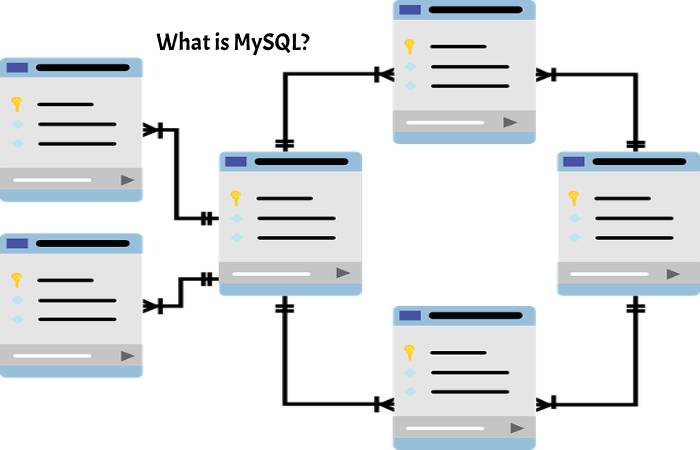
A relational database stores data in separate tables instead of storing all the data in one giant warehouse. Database structures remain organized in physical files optimized for speed. The logical model with objects such as databases, tables, views, rows, and columns provides a flexible programming environment. Set up rules governing relationships between different data fields, e.g., B. One-to-one, one-to-many, unique, required or optional, and “pointers” between other tables. The database enforces these rules, so your application will never see inconsistent, duplicate, orphaned, stale, or missing data with a well-designed database.

The SQL part of “MySQL” stands for “Structured Query Language.” SQL is the most widely used standardized language for accessing databases. Depending on your programming environment, you can either type SQL directly (e.g., generate reports), embed SQL statements in code written in another language, or use a language-specific API that hides the SQL syntax.

SQL is defined by the ANSI/ISO SQL standard. The SQL standard has evolved since 1986, and there are several versions. In this manual, “SQL-92” refers to the standard published in 1992, “SQL:1999” to the standard published in 1999, “SQL:2003” to the current version of the standard. We use the phrase “the SQL standard” to refer to the most current version of the SQL standard.

MySQL software is open source.

Anyone can download MySQL software from the Internet and use it for free. Open source means that anyone can use and change the software. You can study the source code and adapt it to your needs if you want. MySQL software uses the GPL (GNU General Public License), http://www.fsf.org/licenses/, to define what you can and cannot do with the software in different situations. If you are unfamiliar with the GPL or need to embed MySQL code in a commercial application, you can purchase a commercially licensed version from us. For more information, see the MySQL Licensing Overview (http://www.mysql.com/company/legal/licensing/).

MySQL database server is fast, reliable, scalable, and easy to use.

"</p

If that’s what you’re looking for, you should try it. MySQL Server runs conveniently on a desktop or laptop computer and other applications, web servers, etc., requiring little or no attention. If you dedicate an entire machine to MySQL, you can adjust the configuration to use all available memory, CPU power, and I/O capacity. MySQL can also remain scaled to groups of networked machines.

Originally designed to handle large databases much faster than existing solutions, MySQL Server has been used successfully in demanding production environments for several years. Although constantly evolving, MySQL Server today offers a rich and useful feature set. Its connectivity, speed, and security make MySQL Server very suitable for accessing databases on the Internet.

MySQL Server works on client/server or embedded systems.

MySQL database software is a client/server system consisting of a multithreaded SQL server supporting various backends, client programs and libraries, management tools, and a wide range of application programming interfaces (APIs).

We also offer MySQL Server, a built-in, multithreaded library that you can link into your application for a smaller, faster, and easier-to-manage standalone product.

There is a large amount of MySQL-hosted software available.

MySQL Server has several valuable features that have remained developed in close cooperation with our users. The MySQL database server likely supports your preferred application or language.

The official way of pronouncing “MySQL” is “My Ess Que Ell” (not “my continuation”), but we don’t care if you pronounce it as “my continuation” or in some other localized way.

But, I am using Amazon RDS MySql for data storage. I can load data by providing the column values. But, when I try to load the data from my local machine into MySql, it fails with the error: 2068.

The solution that worked for me comes from the workbench shared at the link: Workbench 8.0.12 no longer allows loading local data into a file.

Steps for Mac:

Create a my.cnf file with the following declarations in the path: /etc. After that, I created my .cnf file with the root user.

Set the my.cnf file as the default configuration file in MySql Workbench. In the configuration file, enter the path to the my.cnf file: /etc/my.cnf. Click the wrench icon next to Instance.

Restart the MySQL server workbench.

Try the following statements in MySQL Workbench: SHOW VARIABLES LIKE “local_infile”; //Must be IN SHOW VARIABLES LIKE “secure_file_priv”; //Must not have any values ​​(not NULL but empty)

Load the data.

LOAD DATA LOCAL INFILE ‘<path>/file.csv’ INTO TABLE <tablename>

FIELDS TERMINATED WITH ‘,’

enclosed ‘”‘

LINES TERMINATED by ‘\n’ IGNORE 1 LINES;

With the LOCAL keyword, the upload is successful. However, without the LOCAL keyword, I get an access error.