
If you get two quotes for the same car in the same city, and one ends up being ₹9,400 while the other is ₹14,800, then it’s a big price difference, and neither insurer explains why.
It is clear that someone else is setting these rules. Prices change, but the wording of every policy is the same, and rejected claims always end with the same explanation about terms and conditions.
IRDAI is the body drawing those rules. Understanding what the regulator controls versus what companies decide on their own helps you know which part of your insurance price you can negotiate on.
Table of Contents
Who Decides What Your Policy Costs?
The Insurance Regulatory and Development Authority of India (IRDAI) was created by an Act of Parliament in 1999 to supervise insurance companies and protect the people buying from them. No motor insurer can sell you anything in this country without holding its licence.
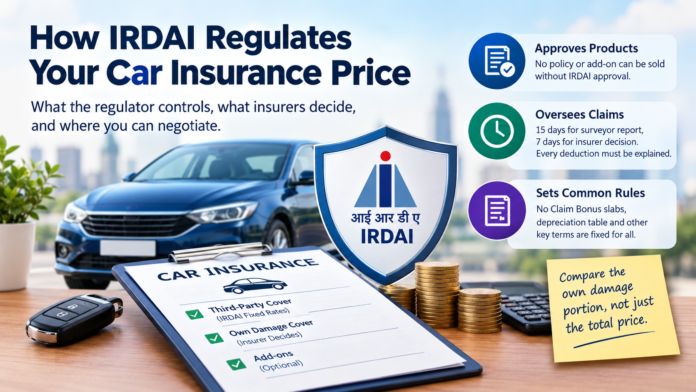
Your premium comes in two parts, and only one of them is free to move. Third-party rates, covering harm you cause to others, are notified centrally under powers given to the regulator, and they depend on engine size rather than on the company selling to you. Own damage rates are set by each insurer from its own claims data, within a framework filed with IRDAI.
Since costs only differ between companies on the “own damage” portion of the price, you should focus your car insurance quotes comparison on that specific half.
Thus, two sellers offering insurance for the same car in the same city can show very different numbers, as they compete on the no-damage cover portion, as the compulsory cover is the same everywhere.
What Does IRDAI Actually Control in Motor Insurance?
- The very first thing it controls is the approval of products. Nobody can invent a cover, an add-on, or a policy without getting approval from the IRDAI, which is why usage-based options such as ‘pay-as-you-drive’ appeared across the market together after a circular was passed in July 2022.
- Claim handling is the second thing it controls, and the more useful one for you. Under the regulator’s 2024 rules on protection of policyholders’ interests, a surveyor has fifteen days from being allotted your claim to submit a report, and the insurer then has seven days to decide. Every deduction must be explained in writing.
- Other parts of the policy are simply fixed for everybody, which includes your No Claim Bonus slabs and the depreciation table used to look for your car’s exact value.
Why Every Policy Reads Almost the Same?
Standard wording is the reason why every policy reads the same. Core sections of a motor policy are common across companies because each version has been filed and cleared against the same template.
Sameness is a gift, not a nuisance. You are not comparing legal documents at car insurance renewal time. Instead, you are only comparing the price, the service, and the add-ons you receive, which is a far easier comparison for people.
Add-ons are the only different part. Companies design add-ons like engine protection, tyre cover, consumables, and roadside on their own way, and the real difference between two policies quoting the same price usually hides in that list.
In 2026, Sabka Bima Sabki Raksha, which was a new law, changed the insurance industry completely. It lets foreign companies fully own insurance firms and creates a special fund to help customers with education and complaints. With more companies now entering the market, insurance prices, especially for ‘own damage’ cover, are expected to become more competitive.
Where Do You Go When an Insurer Says No?
If you have a problem, first contact the insurance company directly. Every insurer is required to have a complaints department, and you must try to resolve the issue with them before taking it any further.
If nothing happens after that, that is when the regulator steps in. Bima Bharosa, the online grievance system run by IRDAI, takes complaints about rejected or delayed motor claims, and a toll-free line on 155255 does the same by phone. Each complaint gets a reference number that you can track.
Unresolved cases can go to the Insurance Ombudsman, which hears disputes free of charge and issues an award the insurer must honour.
It is important to keep note of all of it, from emails and claim numbers to the insurer’s written reason for refusal, as that is what an ombudsman actually reads.
What a Regulator Cannot Do for You
Rules cannot make a bad decision good. If you drove without a valid licence or hid a car modification, no amount of regulation rescues the claim, and the ombudsman will look at it the same way your insurer did.
Regulation helps most with common issues, like missing surveyors, unexplained deductions, or delayed settlements. Those are the fights you can win with a reference number and a deadline, and knowing that changes how you handle the phone call after an accident.