

Table of Contents
Introduction
For small business owners, marketing can often feel like a daunting task reserved for big budgets and large teams. However, effective marketing is less about how much money you spend and more about how well you understand your audience and deliver value.
In a world where consumers are bombarded with thousands of ads daily, small businesses have a unique advantage: authenticity. You are closer to your customers, more agile, and able to create genuine connections that corporations cannot replicate. This guide provides a comprehensive roadmap of essential marketing tips, from low-cost strategies to advanced tactics, designed to help your small business stand out, attract loyal customers, and increase sales.
10 Marketing Tips Every Small Business Should Know
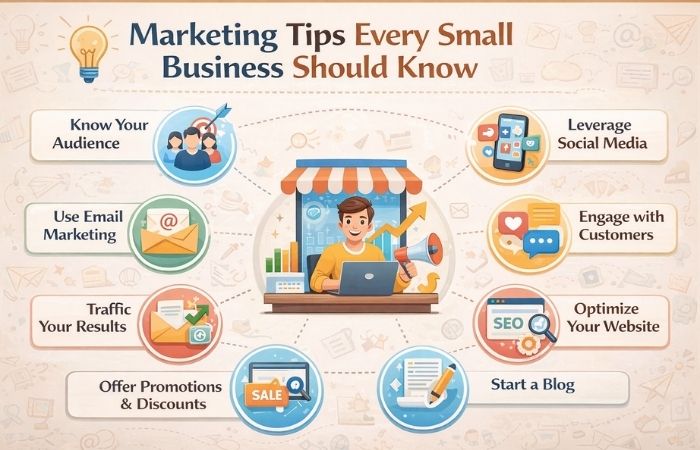
These foundational strategies are non-negotiable for building a sustainable brand.
| Tip | Description | Why It Matters |
|---|---|---|
| 1. Define Your Niche | Don’t try to sell to everyone. Identify your ideal customer (demographics, interests, pain points). | Focused marketing yields higher conversion rates than broad, generic messaging. |
| 2. Optimize Your Google Profile | Claim and update your Google Business Profile with accurate info, photos, and posts. | It is the primary way local customers find you. It boosts local SEO significantly. |
| 3. Leverage Email Marketing | Build an email list from day one. Send newsletters, offers, and updates to subscribers. | Email offers the highest ROI of any marketing channel ($36 for every $1 spent). |
| 4. Master Social Proof | Encourage reviews on Google, Yelp, and social media. Showcase testimonials prominently. | 92% of consumers read reviews before making a purchase. Trust is currency. |
| 5. Create a Simple Website | Your website is your digital storefront. Ensure it is mobile-friendly, fast, and clear. | If customers can’t find you online or your site is broken, they assume you’re out of business. |
| 6. Use Video Content | Create short, engaging videos showing your products, behind-the-scenes, or FAQs. | Video is the most consumed content format and builds trust faster than text. |
| 7. Network Locally | Partner with other complementary local businesses for cross-promotion or events. | It builds community ties and introduces your brand to a ready-made audience. |
| 8. Consistency is Key | Post on social media regularly and maintain a consistent brand voice and visual style. | Sporadic marketing confuses customers; consistency builds recognition. |
| 9. Solve a Problem | Frame your marketing around how you solve a customer’s problem, not just the features of your product. | Benefits sell; features tell. Customers want to know “What’s in it for me?” |
| 10. Track Your Results | Use free tools like Google Analytics and social media insights to see what’s working. | You can’t improve what you don’t measure. Data prevents wasted ad spend. |
5 Low-Budget Marketing Tips for Small Business Owners
Marketing doesn’t have to break the bank. Here are five high-impact strategies that cost next to nothing.
| Tip | Action Steps | Estimated Cost |
|---|---|---|
| 1. Harness the Power of User-Generated Content (UGC) | Run a contest or simply ask customers to post photos with your product using a specific hashtag. Repost this content. | Free |
| 2. Collaborate with Micro-Influencers | Partner with local influencers who have 1,000–10,000 engaged followers. Offer a free product or service in exchange for a post. | Free product or small fee |
| 3. Start a Referral Program | Offer a discount or freebie to existing customers who bring in new customers. Word-of-mouth is the most trusted form of advertising. | Cost of discount |
| 4. Guest Blog or Podcast | Offer to write a guest post for a popular local blog or be a guest on a niche podcast relevant to your industry. | Free |
| 5. Repurpose Existing Content | Turn one blog post into 5 social media posts, a short video, and an email newsletter. Maximize the value of everything you create. | Free |
Uses of Marketing Tips for Small Business
Marketing tips are not just theoretical; they serve specific, practical functions in your business operations. The graph below illustrates the primary ways small businesses utilize marketing advice.
(This is a text-based representation of a graph)
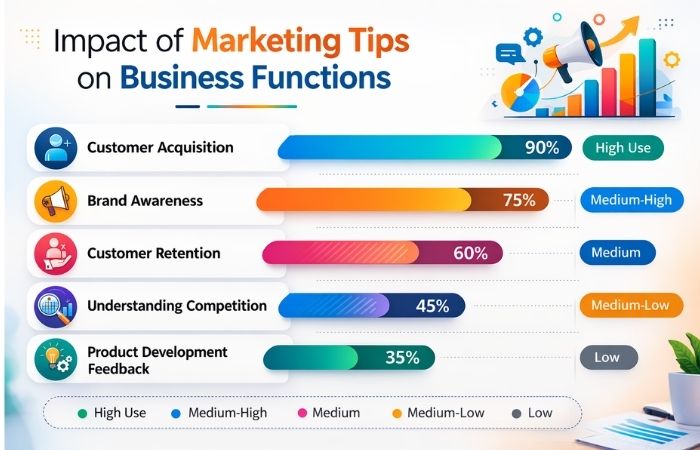
- Customer Acquisition (High Use): Most tips focus on getting new people in the door.
- Brand Awareness (Medium-High): Tips on social media and content help put your name out there.
- Customer Retention (Medium): Tips on email marketing and loyalty help keep customers coming back.
- Understanding Competition: Tips often include “spying” on competitors to see what works.
- Product Development: Listening to marketing feedback helps refine what you sell.
Benefits of Marketing Tips for Small Business
Implementing the right strategies yields tangible benefits that impact your bottom line.
| Benefit | Short-Term Impact | Long-Term Impact |
|---|---|---|
| Increased Visibility | More foot traffic and website visits. | Establishes you as a local authority. |
| Better Customer Engagement | More comments, likes, and direct messages. | Builds a loyal community that advocates for your brand. |
| Higher Sales Conversion | Promotional offers are seen and redeemed. | Consistent branding leads to higher trust and higher ticket sales. |
| Cost Efficiency | Reduces wasteful spending on ineffective ads. | Maximizes ROI, allowing reinvestment into the business. |
| Competitive Advantage | Helps you stand out in a crowded market. | Creates a unique brand identity that is hard to copy. |
Types of Marketing for Small Business
Understanding the landscape helps you choose the right mix for your audience.
| Type | Best For… | Example |
|---|---|---|
| Digital Marketing | Reaching customers online through websites and search engines. | SEO, PPC Ads, Email, Social Media |
| Content Marketing | Educating your audience and building trust over time. | Blog posts, eBooks, Webinars, Podcasts |
| Social Media Marketing | Building a community and showing the “face” of your brand. | Instagram Reels, TikTok, LinkedIn articles |
| Traditional Marketing | Targeting local audiences who may not be heavily online. | Flyers, Billboards, Local Newspaper ads, Radio |
| Guerilla Marketing | Creating a buzz with unconventional, high-impact stunts. | Street art, flash mobs, viral PR stunts |
| Word-of-Mouth Marketing | Leveraging customer satisfaction to generate referrals. | Referral programs, review requests, testimonials |
Marketing Advice for Small Business Owners
Beyond the tactics, here is the mindset advice necessary for success:
-
- Start Before You’re Ready: Don’t wait for the “perfect” logo or website. Launch, get feedback, and iterate. Perfection is the enemy of progress.
- Listen More Than You Talk: Use social media as a listening tool. What are customers complaining about? What do they wish existed? Use this data to shape your offers.
- Don’t Be Afraid to Fire a Customer: If a customer is costing you more in stress and time than they are worth, it’s okay to part ways. Your marketing should attract your ideal customer, not everyone.
- Educate, Don’t Just Sell: The “Know, Like, and Trust” factor is vital. Provide value without asking for anything in return. When they finally need your service, you’ll be the first they call.
How Do Marketing Tips Help Increase Sales?
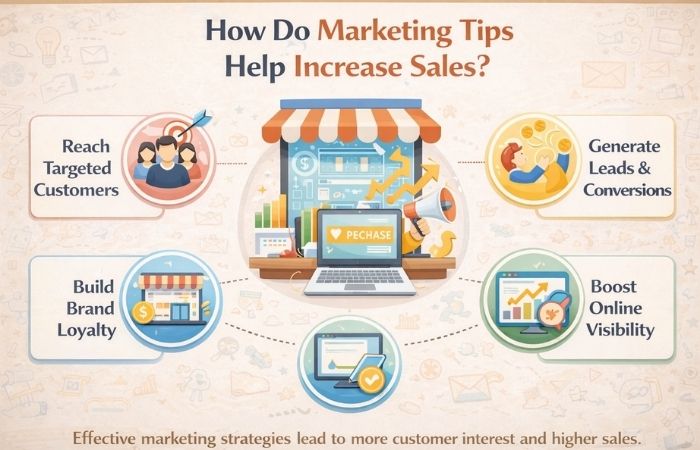
Marketing is the engine that drives sales. Here is the direct correlation.
| Marketing Tip | Psychological Principle | Direct Impact on Sales |
|---|---|---|
| Social Proof (Reviews) | Reduces perceived risk. | Customers are more likely to purchase when they see others had a good experience. |
| Clear Call-to-Action (CTA) | Reduces friction/confusion. | Tells the customer exactly what to do next (“Buy Now,” “Call Today”), shortening the sales cycle. |
| Email Sequences | Principle of Reciprocity & Familiarity. | Staying top-of-mind means when a customer is ready to buy, they choose you. |
| Storytelling | Emotional Connection. | An emotional connection makes price less of a barrier to purchase. |
| SEO (Search Optimization) | Solves an immediate need. | When people search for what you sell, you appear. This captures “high-intent” buyers ready to purchase. |
Marketing Tips That Will Change Your Business Forever
If you only implement three things from this guide, make it these. These are game-changers.
-
- Build an Email List Religiously:
- Why it changes everything: Social media algorithms change constantly. One day, your posts might be seen by 1,000 people; the next, only 100. Your email list is the only audience you truly own. You can reach them anytime, for free. Start building it on day one.
- Master the Art of Storytelling:
- Why it changes everything: Facts tell, but stories sell. People remember stories, not statistics. Share your “Why.” Why did you start the business? What was the struggle? When you humanize your brand, you turn customers into loyal fans who will follow you anywhere.
- Focus on Retention, Not Just Acquisition:
- Why it changes everything: It is 5x to 25x more expensive to acquire a new customer than to keep an existing one. If you focus only on getting new people, you are hemorrhaging money. Implement a loyalty program, check in with past clients, and make them feel valued. A high retention rate is the secret to sustainable, long-term profit.
- Build an Email List Religiously:
Conclusion
Marketing a small business is a marathon, not a sprint. It requires a blend of creativity, analytics, and genuine human connection. By focusing on understanding your customer, delivering consistent value, and building a community around your brand, you can compete with companies that have much larger budgets.
Start small. Pick one or two tips from this guide—perhaps claim your Google Business Profile or start building that email list—and master them before moving on. The most important step is the first one.
FAQs
1. How much should a small business spend on marketing?
A common rule of thumb is to allocate 5-10% of your gross revenue to marketing. If you are a new business or in a highly competitive industry, you may need to be closer to 10-15% to gain traction.
2. Is social media really necessary for all small businesses?
While not every business needs every platform, a social media presence is generally necessary. It acts as social proof and a customer service channel. A B2B welding supply company might only need LinkedIn, while a bakery needs Instagram. Choose the platform where your customers hang out.
3. How long does it take to see results from marketing?
It depends on the strategy. Paid Ads (PPC): Immediate traffic, but can be costly. SEO & Content Marketing: Takes 3-6 months to build momentum, but provides long-term, sustainable traffic. Social Media: Engagement can be immediate, but converting that engagement into sales takes time and nurturing.
4. What is the single biggest marketing mistake small businesses make?
Being inconsistent. Posting three times a day for a week and then disappearing for a month confuses the algorithm and your audience. It is better to post consistently twice a week than to post sporadically seven times a week.
5. Do I need a marketing degree to do this?
Absolutely not. Most successful small business marketing comes from understanding your customer, experimenting, and learning from data. The resources available online (like this guide) are often more practical than formal education.