
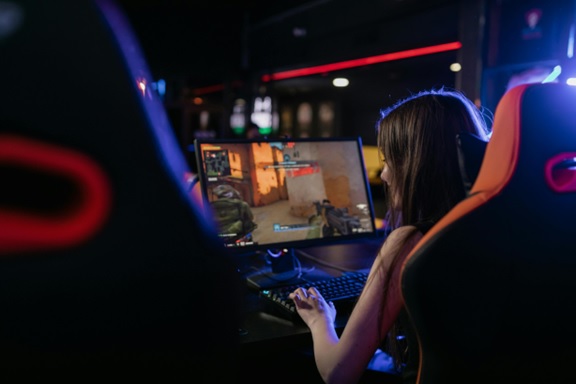
Let’s be honest–online gaming isn’t just evolving anymore. It’s having a complete identity crisis, and honestly? That’s exactly what makes it so exciting right now.
We’re not talking about slightly better graphics or marginally faster load times. The changes happening in 2026 are fundamentally rewiring how we think about gaming itself. Five major tech trends are leading this charge, and they’re worth paying attention to if you care about where this industry’s headed.
Table of Contents
Enhanced Virtual Reality (VR) Immersion
VR has been “the future of gaming” for what feels like forever. But 2026 might actually be the year it delivers on those promises.
The new headsets don’t just look better–they feel different. Haptic feedback has gotten scary good. When you pick up a virtual object, your hands know it. The graphics? They’re finally crossing that uncanny valley we’ve been stuck in for years.
“Half-Life: Alyx” was just the beginning. Developers are now building games that make you forget you’re wearing a headset at all. And here’s what’s interesting: VR isn’t staying in traditional gaming lanes. Fitness apps are exploding. Virtual tourism is becoming a real thing. Your living room can become a workout studio or the streets of Tokyo.
The barrier to entry is dropping fast, too. These aren’t $3,000 toys anymore–well, not all of them.
Blockchain Technology: A New Frontier in Online Gaming
Blockchain in gaming used to sound like tech bro fever dreams. Now? It’s actually solving real problems.
Players can own their in-game items. Actually own them. Trade a rare sword from one game and use the proceeds in another. It sounds simple, but it’s revolutionary for anyone who’s ever lost hundreds of dollars’ worth of skins when a game shuts down.
The crypto poker scene is particularly interesting here. These platforms aren’t just throwing blockchain at poker for the sake of it–they’re using it to guarantee fair play and transparent odds. When you can verify every hand on the blockchain, trust isn’t something you have to hope for anymore.
Sure, there’s still plenty of crypto gaming nonsense out there. But the legitimate applications are starting to separate themselves from the get-rich-quick schemes.
Augmented Reality (AR) Gaming
Remember when Pokémon GO had everyone walking into traffic? That was just AR’s awkward teenage phase.
2026’s AR is more sophisticated. The overlays actually stay where they’re supposed to. The interactions feel natural instead of gimmicky. Developers are figuring out how to use real-world spaces creatively instead of just dropping digital objects randomly onto sidewalks.
Location-based gaming is getting genuinely clever. Imagine puzzle games that use your actual neighborhood as the game board, or adventure games where that coffee shop down the street becomes a quest hub.
The social aspect is huge too. AR games can bring people together in physical spaces in ways that traditional online gaming just can’t match.
Cloud Gaming and Streaming Services
This one’s personal for me. I’ve been gaming on a laptop that sounds like a jet engine for too long.
Cloud gaming is finally hitting its stride. Google Stadia crashed and burned, but Xbox Cloud Gaming and NVIDIA GeForce Now learned from those mistakes. The latency issues that used to make competitive gaming impossible? Mostly solved, especially with 5G rolling out everywhere.
You can play Cyberpunk 2077 on your phone now. That’s not a gimmick–that’s a fundamental shift in who gets to be a gamer. No more $2,000 gaming rigs required. No more waiting three hours for updates to download.
Cross-platform play becomes trivial when everything’s running on the same servers. Your save games follow you everywhere. It’s gaming without the hardware headaches.
AI and Machine Learning in Game Development
AI in games used to mean “enemy walks into a wall repeatedly.” Not anymore.
Modern AI creates content on the fly. Every playthrough of certain games is genuinely unique because the AI is generating new scenarios, new dialogue, and new challenges based on how you play.
NPCs are getting smarter, too. They remember your choices. They adapt to your playstyle. Some of them are becoming genuinely convincing conversationalists–which is both impressive and slightly unsettling.
Behind the scenes, AI helps developers understand what keeps players engaged and what makes them quit. Games are becoming more personalized without feeling manipulative about it.
The Bottom Line
Gaming in 2026 isn’t just about better technology–it’s about removing barriers. Barriers between digital and physical worlds. Barriers between players and high-end gaming. Barriers between gaming and real economic value.
Not every trend will pan out exactly as promised. Some will probably crash spectacularly. But the overall direction is clear: gaming is becoming more accessible, more social, and more integrated into our daily lives.
Whether that’s exciting or terrifying probably depends on how much you like change. But ready or not, it’s happening.