
Table of Contents
What Time Was It 4 Hours Ago?
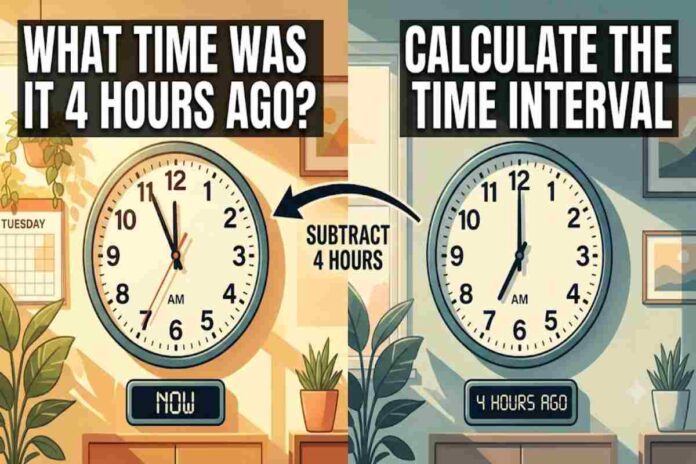
What time was it 4 hours ago? Simply subtract 4 hours (240 minutes) from the current time. For example, if it is 11:57 AM now, four hours earlier was 7:57 AM on the same day. If subtracting four hours takes you past midnight, the answer falls on the previous calendar day.
The important point is that there is no single permanent answer to this question. The result changes continuously because it depends on when you do the calculation and which time zone you use.
How to Calculate 4 Hours Ago
The calculation is straightforward:
Current time − 4 hours = time 4 hours ago
For example:
| Current time | 4 hours ago |
|---|---|
| 8:00 AM | 4:00 AM |
| 10:30 AM | 6:30 AM |
| 2:00 PM | 10:00 AM |
| 6:45 PM | 2:45 PM |
| 11:15 PM | 7:15 PM |
| 2:00 AM | 10:00 PM previous day |
Four hours equals 240 minutes or 14,400 seconds, so you can also calculate the interval using minutes or seconds.
A quick mental method
If the current time is 9:40 PM, move the hour hand backward four hours:
9:40 PM → 8:40 PM → 7:40 PM → 6:40 PM → 5:40 PM
Therefore, four hours ago was 5:40 PM.
What If 4 Hours Ago Was Yesterday?
This is where date awareness becomes important.
Suppose the current time is 2:30 AM on Thursday. Subtracting four hours gives:
2:30 AM Thursday − 4 hours = 10:30 PM Wednesday
The time changed, but so did the date.
This is why a reliable time calculator should show both the time and date, particularly when the calculation occurs close to midnight. Online time calculators similarly account for the possibility that subtracting a duration crosses a calendar boundary.
What Time Was It 4 Hours Ago in Different Time Zones?
The answer depends on the reference location.
For example, imagine a particular instant corresponds to:
| Location | Local time |
|---|---|
| India | 10:00 AM |
| London | 5:30 AM |
| New York | 12:30 AM |
| Los Angeles | 9:30 PM, previous day |
Four hours should be subtracted from the local time you’re interested in. When comparing countries, it is better to identify the time zone first rather than simply subtracting hours from a clock reading.
A time-zone converter can help compare locations and account for their differences.
Why Does “4 Hours Ago” Keep Changing?
Unlike a fixed date, “4 hours ago” is a relative time expression.
If it is:
- 9:00 AM now → 5:00 AM was four hours ago
- 10:00 AM now → 6:00 AM was four hours ago
- 11:00 AM now → 7:00 AM was four hours ago
- 12:00 PM now → 8:00 AM was four hours ago
The answer moves forward at exactly the same rate as the current clock.
That is why websites offering live calculators generally calculate the result from the visitor’s current time and time zone rather than publishing one static answer.
When Is This Calculation Useful?
Knowing the time four hours earlier can be useful for more than simple curiosity.
Work and activity logs
If you remember that something happened “four hours ago”, calculating the actual clock time can help reconstruct a timeline.
Travel
Four-hour differences can matter when checking flight schedules, connections and events across different time zones.
Digital activity
You may want to determine approximately when a message, notification or online activity occurred when an app displays relative timing.
Time-based routines
Some routines are measured in fixed hourly intervals. However, for medication or other health-related schedules, the clock calculation should not replace instructions from a doctor, pharmacist or product label.
4 Hours Ago vs 4 Hours From Now
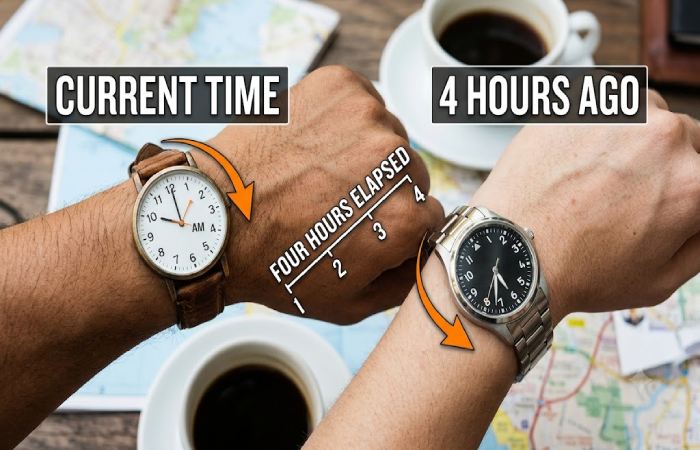
These phrases sound similar but describe opposite calculations.
| Phrase | Operation |
|---|---|
| 4 hours ago | Subtract 4 hours |
| 4 hours from now | Add 4 hours |
For example, if the current time is 3:00 PM:
- 4 hours ago = 11:00 AM
- 4 hours from now = 7:00 PM
The distinction becomes particularly important around midnight because adding or subtracting hours can change the calendar date.
How Many Minutes and Seconds Are 4 Hours?
The conversion is:
4 hours = 240 minutes
And:
4 × 60 × 60 = 14,400 seconds
So “four hours ago” means exactly 14,400 seconds before the current instant, assuming you are measuring elapsed time rather than dealing with a special clock adjustment.
This makes the calculation useful for software, timestamps and other situations where time is represented numerically.
Conclusion
Calculating back four hours is straightforward to answer in this context. It varies as of when & from where. However, subtract four hours from the current time & then check whether midnight has occurred & including the time-zone relevant for precise accuracy. Suffices for this casual question about what time was it 4 hours ago.